Who Picks the Referees? Why I'm Voting No on State Question 845
In a football game, would you let the home team pick the referees?
Of course not. But that's close to what State Question 845 would allow for the people who pick Oklahoma's top judges.
Oklahoma's Supreme Court was once for sale
More than sixty years ago, Oklahoma's Supreme Court was rocked by the worst judicial scandal in the state's history. Three justices were implicated in bribery and corruption. One confessed. One resigned. One was impeached and removed.
It was national news. In April 1965, Time magazine wrote: "Little in U.S. judicial history comes close to matching the scandal now swirling around the Oklahoma State Supreme Court."
Oklahomans fixed it. On July 11, 1967, voters changed the state constitution and created the Judicial Nominating Commission. It's the same basic model a majority of states use today to pick their top judges.
How the commission works
When there's an opening on the Supreme Court or the Court of Criminal Appeals, 15 citizens on the commission screen the applicants. They vet them, check their records and research their work. Then they send the governor three qualified names, and the governor picks one.
The commission was built with guardrails so no one person or party could control it. Here's who sits on it today:
6 picked by the governor. They have to be everyday citizens, not lawyers. No more than three can be from the same party.
6 elected by lawyers in the Oklahoma Bar Association, one from each district.
3 at-large members. One picked by the Speaker of the House, one by the Senate President Pro Tem, and one chosen by the other commissioners. No more than two can be from the same party.
The governor's picks and the at-large members also can't serve back-to-back terms.
What SQ 845 changes
State Question 845 eliminates all three guardrails:
The party limits are gone.
Every appointee could come from the same party.The no-lawyers rule is gone.
The governor's picks could be lawyers, including lawyers who argue cases in front of the same judges they help choose. Six seats already belong to lawyers. The governor's six are supposed to give regular people a real voice.The ban on back-to-back terms is gone.
Members could serve up to 12 years in a row.
It also updates the commission's districts to match today's congressional map. That part is reasonable on its own. It doesn't need the rest attached to it.
Why that's a real problem
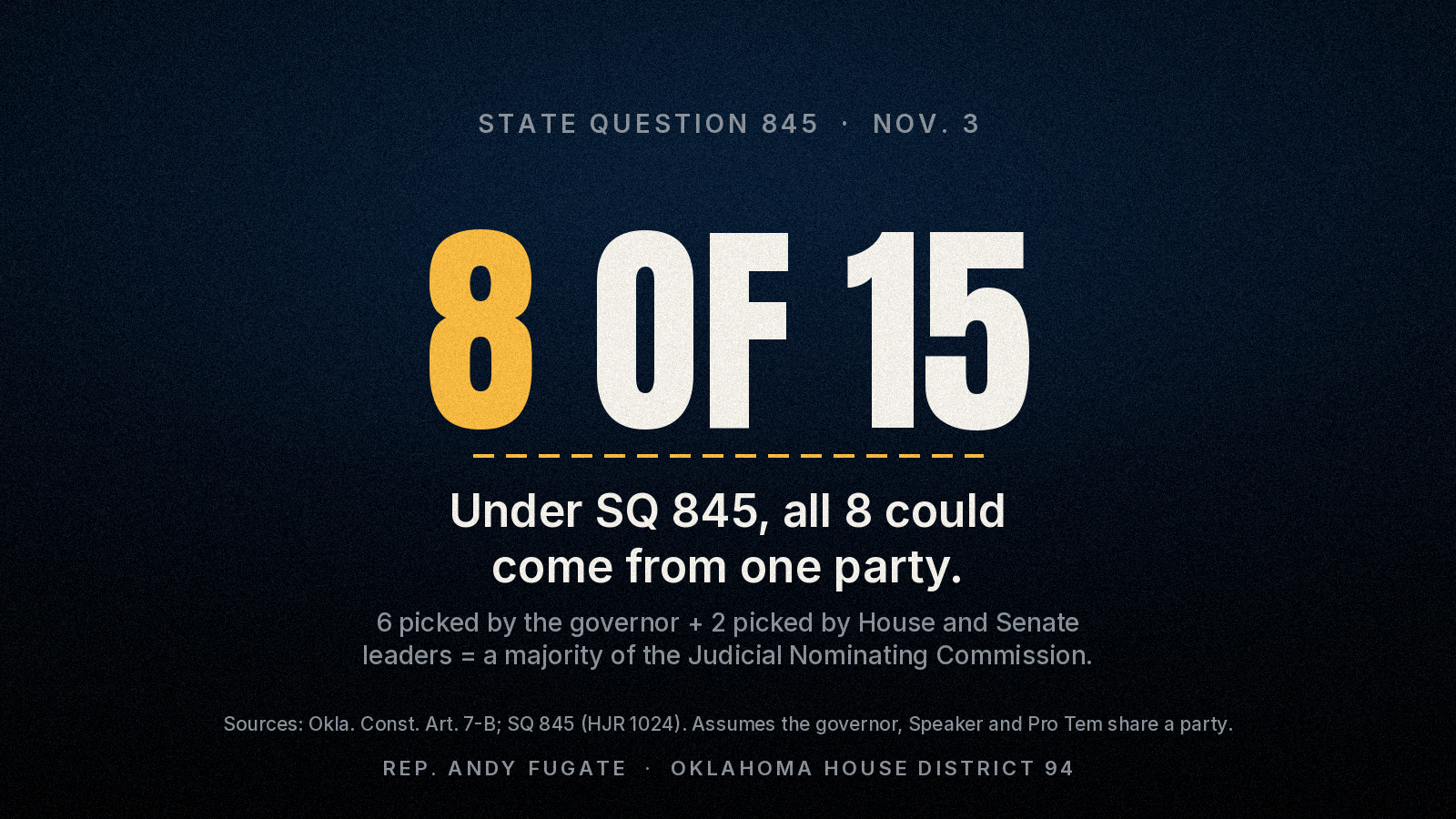
Do the math. Six seats picked by the governor. Two more picked by House and Senate leaders. That's eight of fifteen. A majority.
Today the governor, the Speaker and the Pro Tem all belong to the same party. Under SQ 845, all eight of their picks could legally come from that party too. One party could control the commission that decides which three names go to the governor.
The Senate author of the measure, Sen. Todd Gollihare, was open about the goal. When he presented the bill on the floor, he said, "It's not really equitable for the majority party to only have five commissioners where the minority has 10."
That’s crazy talk. The rules aren't supposed to be fair to either party. They're supposed to be fair to all Oklahomans.
This isn't about which party is in charge
I would vote no on this even if we had a Democrat in the governor’s mansion. Fixing the 1960s scandal took both parties. Republican Govs. Henry Bellmon and Dewey Bartlett pushed for court reform, and voters approved it. Taking the guardrails down would hand whoever holds power a commission built in their own image, whichever party that is.
Judges should answer to the law. They should NEVER answer to a party.
Let's not go back 60 years. Join me in voting no on State Question 845 on Tuesday, Nov. 3.
Sources
Oklahoma Constitution, Article 7-B, which sets up the Judicial Nominating Commission
Oklahoma Policy Institute
State Question 845: Changes to Judicial Nominating CommissionOklahoma Voice, April 9, 2026
Senate passes ballot measure to overhaul Oklahoma judicial selectionOklahoma Watch
State Question 845: What Oklahoma voters need to know before November 3Oklahoma Bar Journal, May 2023
From the Ashes of Scandal Came Court ReformTime, "Oklahoma's Shocking Scandal," April 16, 1965, p. 47
William A. Berry and James Edwin Alexander
Justice for Sale: The Shocking Scandal of the Oklahoma Supreme Court